

Surviving the age of AI

Cinema has gone through major evolutions before. From the invention of the Cinématographe in 1896, to the first CGI character The Stained Glass Knight in 1985, to more recent breakthroughs like virtual production using game engines in The Mandalorian. Each shift felt disruptive in its own time, changing how films were made and who could make them.
But nothing quite compares to what we’re seeing now.
AI has become the keyword of 2025, and for good reason. When generative video first appeared, many of us remember that funny clip of Will Smith eating spaghetti (2023).

Fast forward to today, and the gap is staggering in just 2 years.
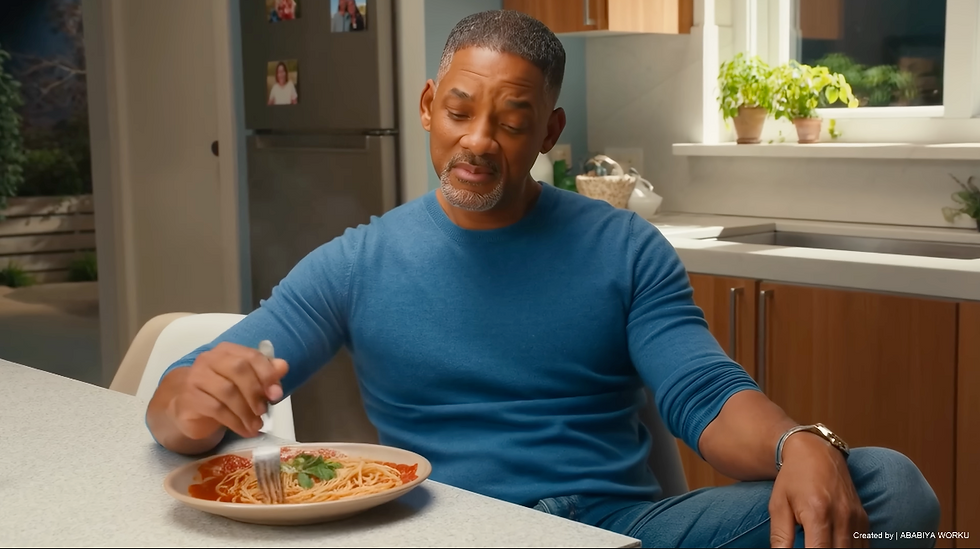
AI-generated imagery is sharper, more coherent, more cinematic, and improving at a pace that’s hard to ignore. There’s no denying it anymore: AI has arrived in filmmaking, and it’s here to stay. It will continue to reshape how films are planned, visualized, and produced.
The real question is no longer whether AI will replace filmmakers.
It’s which filmmakers will adapt, and which will struggle.
At FA Production, we thought this was a good moment to pause and reflect. So in this blog, we explore some of the core skillsets and mindsets that will matter most if we want to keep doing meaningful creative work in the age of AI.
1. Taste will matter more than technique
AI is getting remarkably good at generating cinematic images, lighting setups, and even complex VFX. What it doesn’t know is whether a scene feels right.
Knowing what’s appropriate for a story, a brand, a cultural context cannot be automated. Your taste is built through experience, reference, failure, and attention. Two filmmakers can use the same tools and produce wildly different results, simply because their sense of taste is different.
Now, in practice, how to develop your taste? Short answer is: good input = good output. The first and often the easiest thing we can all do is to watch good materials, every day. Vimeo, ads of the world, and nowness are all good places to start.
2. Storytelling is still king
Ask anyone working in film today and they’ll tell you the same thing: AI can now generate shots they could only dream of executing in real life. But ask AI to come up with a story, an idea, or a meaningful narrative and most results still feel flat and generic.
Why? Because LLMs like ChatGPT and Gemini thrive on generalization, while stories are deeply personal. They’re shaped by lived experience, cultural nuance, contradiction, and emotions. They don’t come from patterns alone.
Technology can help visualize ideas faster and support brainstorming, but it can’t replace the instinct that says, “this is the angle to tell this story.”
Our general rule of thumb: never touch an AI engine till after you have finished your first idea draft, it can be a bad draft, but you have to make your mind work first before asking for assistance.
3. Build a hybrid workflow
Surviving the age of AI doesn’t mean abandoning everything you already know. It means integrating AI thoughtfully into existing workflows.
AI can support ideation, visualization, organization, and technical tasks. But it works best when guided by clear creative direction and strong fundamentals. A hybrid workflow allows teams to move faster without losing control, to explore more options without drowning in them.
To be honest, it's a learning curve for all of us at FA Production too. Our workflow integration is still early, but it's improving fast in 2026.
4. Enhance the human connection
Ironically, as AI takes on more of the technical heavy lifting, human relationships become even more important. At the end of the day, it’s where the fun and fulfillment come in - cooperating with other people, and making something out of nothing.
Filmmaking has always been a people business, and AI isn’t changing that any time soon.
In fact, in a world saturated with generated content, audiences gravitate even more toward work that feels intentional, honest, and human. The ability to listen, empathize, and collaborate remains irreplaceable.
5. Some things AI can’t touch (yet)
There’s a running joke at FA Production that if things get really wild, we can always go back to shooting weddings (like we did 10 years ago when we started). And while it’s half a joke, there’s truth in it.
Real events, documentaries, unscripted human moments - these are still largely safe from AI. You can’t fake genuine emotion, real-time interaction, or lived experience in a meaningful way.
As long as there are real people living real lives, there will be a place for filmmakers who can observe, interpret, and tell those stories with care.
Moving forward: our perspective
Let’s make something clear: We’re neither pro nor anti-AI. We’re just watching it closely, learning how it works, and thinking critically about where it fits into our workflow. At the same time, we’re doubling down on what makes us valuable: our understanding of Vietnamese audiences, our relationships with clients, our storytelling instincts, and our ability to solve creative problems thoughtfully.
The future of filmmaking isn’t about competing with AI. It’s about being so strong at the human parts of the job that AI becomes a tool that amplifies your work, not a threat that replaces it.
Every major technological shift in film history, from sound to color to digital, once felt like one big step into the uncertainty. This AI revolution feels big, but in hindsight, it’s no different. Just another technical evolution.
And like all technical evolutions, it simply changes what we need to be good at.

Comments